
During summer traffic stops in Georgia, law enforcement may search a vehicle or cooler only under specific legal conditions such as consent, probable cause, arrest-related circumstances, or inventory procedures. Many drivers are unaware of how quickly a routine stop can escalate into a full search of containers inside the vehicle. Brett Willis Law LLC regularly defends individuals in Gainesville, Georgia, who face DUI or drug-related charges that begin with these types of searches. Understanding your rights in these moments can make a significant difference in how a case develops.
Harvard Law School Trial Advocacy Instructor Justia 10.0 Lawyer Rating 10 Lawyers You Need to Know Top 100 National Trial Lawyers Avvo Rating 10 Faculty Faculty, Bill Daniel Trial Advocacy Program Rated by SuperLawers






Summer Traffic Stops and Why Searches Often Escalate Quickly 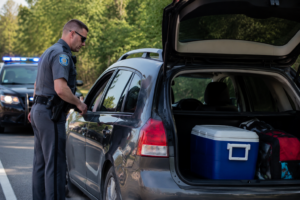
Warm weather travel in Georgia often means more vehicles on the road, more vacation travel, and more roadside enforcement activity. During these stops, officers are frequently alert for signs of alcohol, drugs, or other violations, and items commonly found in vehicles, such as coolers, backpacks, and storage bins can become focal points of attention. Brett Willis Law LLC, based in Gainesville, Georgia, routinely handles cases where a simple traffic stop escalates into a full search of a vehicle after an officer notices something that raises suspicion.
A driver may believe the stop is routine, especially when the reason is something minor like a tag issue or lane violation. However, once an officer begins questioning, observing behavior, or noticing containers inside the vehicle, the situation can shift quickly. A cooler in the back seat or trunk is often treated as something worth investigating further, even when it contains nothing more than drinks or personal items.
Constitutional Protections That Apply to Vehicle Searches
The Fourth Amendment protects individuals from unreasonable searches and seizures, but vehicle stops operate under rules that are more flexible than home searches. Courts have long recognized that vehicles can be searched without a warrant in certain situations due to mobility and public safety concerns. That flexibility does not mean officers can search freely without limits.
In Georgia, a search must generally be supported by consent, probable cause, a lawful arrest, or an administrative procedure such as an inventory search after towing. Without one of these legal justifications, evidence found inside a vehicle may be challenged later in court.
Understanding these boundaries is critical because many people do not realize they can refuse consent or question the basis of a search. Once consent is given, the scope of the search can expand to include nearly every part of the vehicle, including containers like coolers.



When Consent Changes Everything During a Traffic Stop
Consent is one of the most common reasons vehicle searches occur. If an officer asks for permission to search and the driver agrees, the search becomes lawful regardless of whether probable cause exists. Many drivers feel pressured at the moment and do not fully understand that consent is optional.
Once consent is given, officers may search areas throughout the vehicle, including locked or closed containers, depending on the scope of the permission granted. That includes coolers, backpacks, grocery bags, and storage bins. Even a brief “yes” can allow a search that becomes much broader than expected.
In many Georgia cases handled by Brett Willis Law LLC, drivers later report they did not feel they had a real choice when they agreed. Courts examine whether consent was voluntary, but proving pressure or misunderstanding requires a careful legal analysis of the encounter.
Probable Cause and How It Applies to Coolers and Containers
Probable cause allows officers to search a vehicle when they have a reasonable belief that evidence of a crime is inside. This standard is lower than proof beyond a reasonable doubt but must still be based on specific facts, not assumptions.
Examples of probable cause during summer traffic stops may include the smell of alcohol or marijuana, visible open containers, admissions by occupants, or behavior suggesting impairment. Once probable cause exists, officers may search the entire vehicle, including containers like coolers.
Under what is known as the automobile exception, the search is not limited to just what is visible. If a cooler is present and officers believe it could contain contraband or evidence, it may be opened and inspected.
SM was a well-known DJ who was stopped on I-85 and arrested for DUI, and his license was taken for a year. A few months later, he got another DUI in a different county. We helped get the second DUI reduced to Reckless Driving with only a $50 fine, and we proved the first officer had no right to stop him. Because of that, the first DUI was dismissed. JF parked at a Publix, police showed up and started bothering him and his friends. They tried to pressure him into letting them search his car, and when he said no, they claimed they saw a vape pen and searched anyway. JF was arrested & charged with several felonies. We filed a motion to suppress the evidence, and they dropped all the charges. Pam killed her longtime boyfriend with a knife one night in their apartment. Our investigation uncovered that Pam had long suffered physical and mental abuse at this man’s hands. Prior to trial, we were able to convince the prosecution agreed to dismiss the murder charges. Pam is now back home with her family.
How Coolers Are Treated Under Georgia Search Law
A cooler inside a vehicle is legally treated as a container, meaning it does not receive special protection simply because it is sealed or used for personal storage. If a lawful search of the vehicle is justified, the cooler can also be searched.
This often surprises drivers who assume that personal storage items are off limits. In reality, courts generally allow containers within vehicles to be searched if the underlying search is lawful. This is especially relevant in DUI investigations where officers may suspect alcohol is being transported or consumed.
A cooler filled with beverages after a lake trip may appear harmless, but once a lawful search begins, its contents may still be inspected. The key legal question is not what the cooler contains, but whether the officer had a valid reason to search the vehicle in the first place.
Traffic Stops, DUI Investigations, and Summer Travel in Georgia
Summer driving in Georgia often involves travel to lakes, rivers, and vacation destinations. These environments frequently overlap with DUI enforcement efforts, which means officers may be more alert to indicators of alcohol consumption.
A traffic stop that begins with a minor violation can quickly evolve into a DUI investigation if officers observe signs such as delayed responses, inconsistent statements, or containers that appear to contain alcohol. Once that investigation escalates, a vehicle search may follow.
Brett Willis Law LLC regularly defends clients whose DUI cases begin with stops that escalated from ordinary travel situations. These cases often involve questions about whether the search was justified or whether officers exceeded the scope of their authority.
You can learn more about related DUI issues here:
https://www.brettwillislaw.com/what-is-a-dui
https://www.brettwillislaw.com/what-are-the-consequences-of-a-dui-in-georgia
https://www.brettwillislaw.com/what-should-you-do-if-you-are-stopped-for-dui
https://www.brettwillislaw.com/can-i-refuse-a-breathalyzer
https://www.brettwillislaw.com/can-you-challenge-the-results-of-a-dui-breathalyzer-or-blood-test-in-georgia
Your Rights During a Traffic Stop in Georgia
Drivers often underestimate how important it is to understand their rights during a stop. In most situations, you are not required to consent to a search of your vehicle. You also have the right to remain silent beyond providing identification and basic information required by law.
Officers may ask questions designed to build probable cause, and the way a driver responds can influence whether a search occurs. Calmly declining consent is legally permitted, although the situation must still be handled respectfully to avoid escalation.
Knowing when you can refuse and how to communicate that refusal can significantly impact what happens next during the stop.
What Happens When a Search Is Not Legally Supported
If a vehicle or cooler is searched without valid legal justification, the evidence obtained may be challenged in court. This is often done through a motion to suppress, which asks the court to exclude evidence that was obtained unlawfully.
If the court agrees that the search violated constitutional protections, the prosecution may lose key evidence needed to support the case. This can lead to reduced charges or dismissal in certain situations.
Defense attorneys in Georgia carefully examine whether officers had probable cause, whether consent was voluntary, and whether the search exceeded legal limits.
Legal Defense Strategies in Vehicle Search Cases
Cases involving vehicle searches often turn on small but important details. Defense strategies may focus on whether the stop itself was lawful, whether the officer’s observations actually supported probable cause, or whether the search expanded beyond what was legally allowed.
Coolers, glove compartments, trunks, and personal bags are often central to these disputes. Each container must be evaluated in context with the justification provided by law enforcement.
Brett Willis Law LLC regularly evaluates these issues for clients in Gainesville and surrounding areas, particularly in DUI and drug-related cases where vehicle searches play a central role in the evidence.
Helpful resources include:
https://www.brettwillislaw.com/can-i-refuse-a-field-sobriety-test
https://www.brettwillislaw.com/what-are-my-rights-as-a-criminal-defendant-in-georgia
https://www.brettwillislaw.com/what-happens-to-driving-privileges-after-a-dui-arrest
How Brett Willis Law LLC Assists Clients in These Situations
Brett Willis Law LLC provides defense for individuals facing charges that stem from traffic stops and vehicle searches throughout Gainesville, Georgia. Attorneys Brett Willis and Chris van Rossem carefully review each stage of the stop, from the initial reason for pulling the vehicle over to the final search and arrest.
These cases often involve constitutional issues that can significantly affect the outcome. A detailed review of officer conduct, search justification, and evidence handling is essential in building a strong defense.
The firm offers a free consultation to individuals facing DUI or criminal charges in Georgia.
Vehicle searches during summer traffic stops in Georgia are governed by strict legal rules, even though they may appear routine or automatic in practice. Consent, probable cause, arrest-related authority, and inventory procedures are the primary ways officers can lawfully search a vehicle and its contents, including coolers. Understanding these rules helps protect your rights and ensures that unlawful searches can be properly challenged when they occur.
This information is for educational purposes only and is not legal advice. Consult an attorney about your specific situation.